
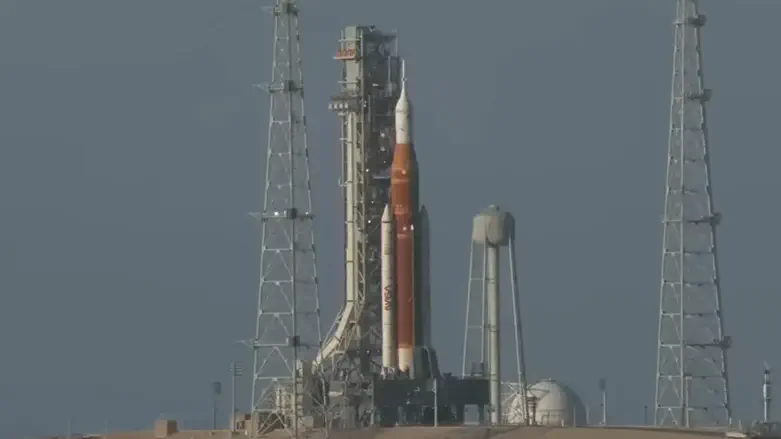

La NASA lanza la histórica misión Artemis II, marcando una nueva era en la exploración del espacio profundo
<!–>
More than 53 years after the historic Apollo 11 Moon Landing, NASA has launched the Artemis II mission from Kennedy Space Center in Florida-a crewed spaceflight that will travel close to the Moon and mark a major step in the United States’ plan to return humans to lunar orbit and eventually land on its surface again.
“Today’s launch marks a defining moment for our nation and for all who believe in exploration. Artemis II builds on the vision set by President Donald J. Trump, returning humanity to the Moon for the first time in more than 50 years and opening the next chapter of lunar exploration beyond Apollo. Aboard Orion are four remarkable explorers preparing for the first crewed flight of this rocket and spacecraft, a true test mission that will carry them farther and faster than any humans in a generation,” said NASA Administrator Jared Isaacman. “Artemis II is the start of something bigger than any one mission. It marks our return to the Moon, not just to visit, but to eventually stay on our Moon Base, and lays the foundation for the next giant leaps ahead.”
The mission, which faced multiple delays due to technical issues including hydrogen leaks and spacecraft system malfunctions, is considered a key milestone in the broader Artemis program. The initiative aims to establish a sustained human presence beyond Earth. According to NASA, this mission is a necessary step toward future crewed landings on the Moon and eventually human missions to Mars.
“Artemis II is a test flight, and the test has just begun. The team that built this vehicle, repaired it, and prepared it for flight has given our crew the machine they need to go prove what it can do,” said NASA Associate Administrator Amit Kshatriya. “Over the next 10 days, Reid, Victor, Christina, and Jeremy will put Orion through its paces so the crews who follow them can go to the Moon’s surface with confidence. We are one mission into a long campaign, and the work ahead of us is greater than the work behind us.”
At the center of the mission is an international crew of four astronauts, reflecting a broader shift in the approach to modern space exploration. The mission is commanded by Reid Wiseman, a former U.S. Navy test pilot. He is joined by Victor Glover, who will become the first black astronaut to travel into deep space; Christina Koch, who will be the first woman to venture beyond low Earth orbit; and Jeremy Hansen of the Canadian Space Agency, the first non-American astronaut assigned to a lunar mission.
According to mission plans, the Orion spacecraft will first enter orbit around Earth for system checks and maneuvers before beginning a four-day journey toward the Moon. At its peak, the spacecraft will travel approximately 6,500 kilometers beyond the far side of the Moon, potentially setting a new record for the farthest distance humans have ever traveled from Earth-over 400,000 kilometers. During this phase, communication with Earth is expected to be lost for about 41 minutes. The spacecraft will then begin its four-day journey back to Earth.
The mission has received widespread international coverage, with many outlets emphasizing that it represents not only a technological achievement but also a strategic move. At a time when other global powers-particularly China-are advancing their own lunar ambitions, including plans for bases on the Moon, the Artemis program is widely viewed as part of a renewed geopolitical competition in space.
Despite the excitement, the mission has also drawn criticism, mainly due to its high costs and repeated delays. Nonetheless, NASA maintains that the investment is essential for long-term technological development, international cooperation, and laying the groundwork for human settlement beyond Earth.
Artemis II will not land on the Moon, but it is considered a critical step toward that goal. Its success is expected to pave the way for future missions in the Artemis program, including Artemis III, which aims to achieve the first crewed lunar landing since the Apollo era.
–>
Fuente original: Leer nota completa